
The story
Origins and historical context
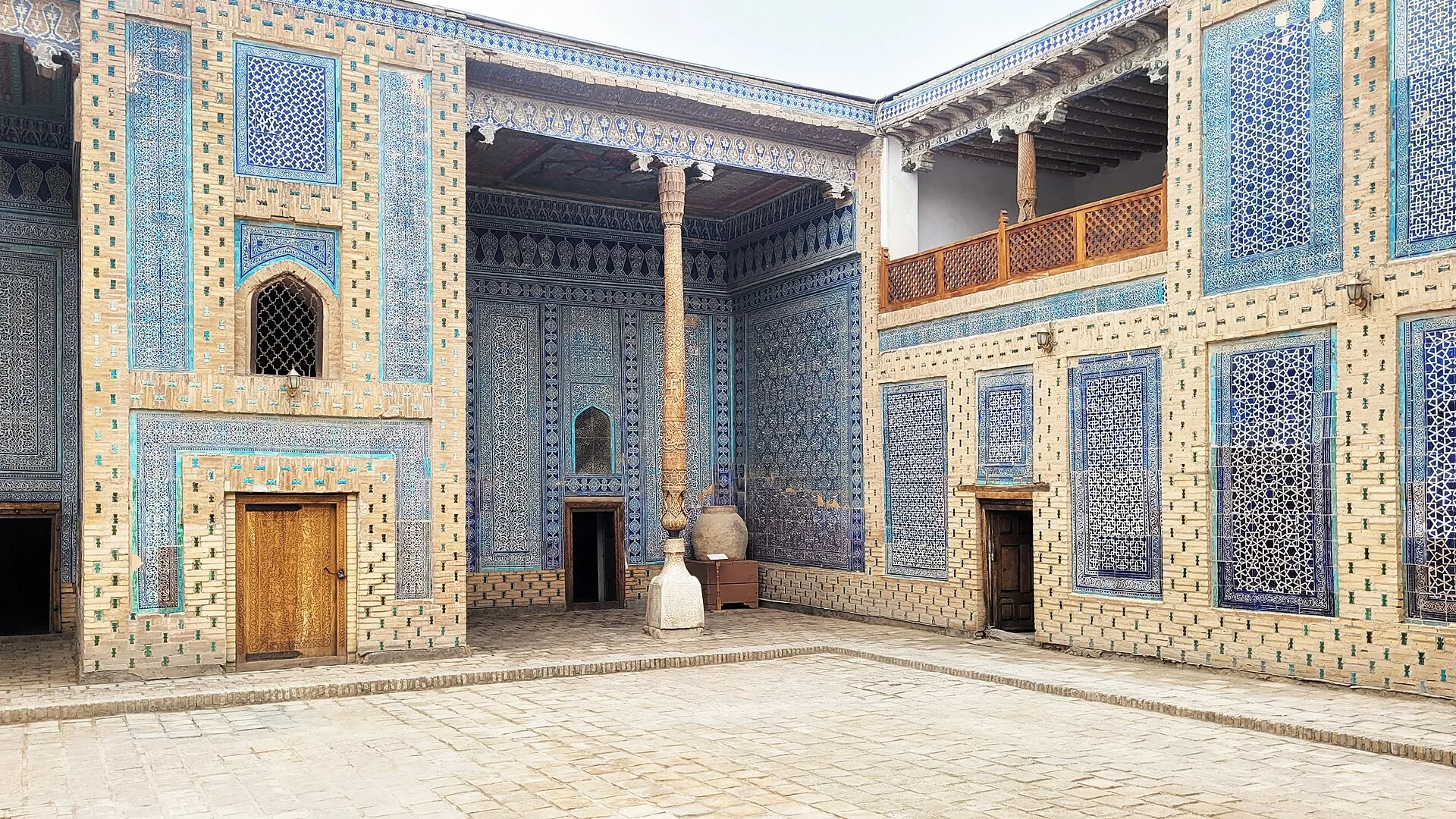
Allakuli Khan commissioned Tash Hauli, or the Stone Courtyard, in the 1830s as a new royal residence within Itchan Kala. Construction produced a complex of ceremonial, residential and service courts rather than one symmetrical palace block.
Architecture and use
The harem, reception spaces and court areas are distinguished by tall iwans, carved wooden columns and blue-and-white tilework. Decoration communicates hierarchy while responding to shade and airflow in Khiva’s climate.
Later history and interpretation
Stories about the speed of construction and punishments imposed on builders circulate widely; they should be treated as tradition unless tied to a documented source. Read the palace through movement between courtyards and changes in privacy.
Why it matters
Visit Tash Hauli Palace to understand a distinct layer of Khiva and Khorezm beyond a checklist of façades.
Highlights
- Origins and historical context
- Architecture and use
- Later history and interpretation
Gallery
Practical notes
Wear comfortable shoes for stone, brick and uneven walking surfaces. In hot weather, plan shade and water breaks and confirm current access locally.
Suggested visit: 70 min.
Add this place to your Uzbekistan journey.
Save the places that interest you, arrange the order, then request transport directly in WhatsApp.