
The story
Origins and context
Construction began after Timur’s Indian campaign and was largely completed around 1404. Court chronicles present it as a project of imperial scale, drawing craftsmen and materials from across Timur’s domains.
Architecture and meaning
The traditional name links the mosque to Saray Mulk Khanum, known as Bibi-Khanym. Popular stories about an architect and a forbidden kiss are later legends and should not be treated as documented construction history.
Later history and interpretation
Structural ambition exceeded what some elements could safely sustain. Damage accumulated through time and earthquakes; twentieth- and twenty-first-century restoration reconstructed major parts of the complex.
What to notice
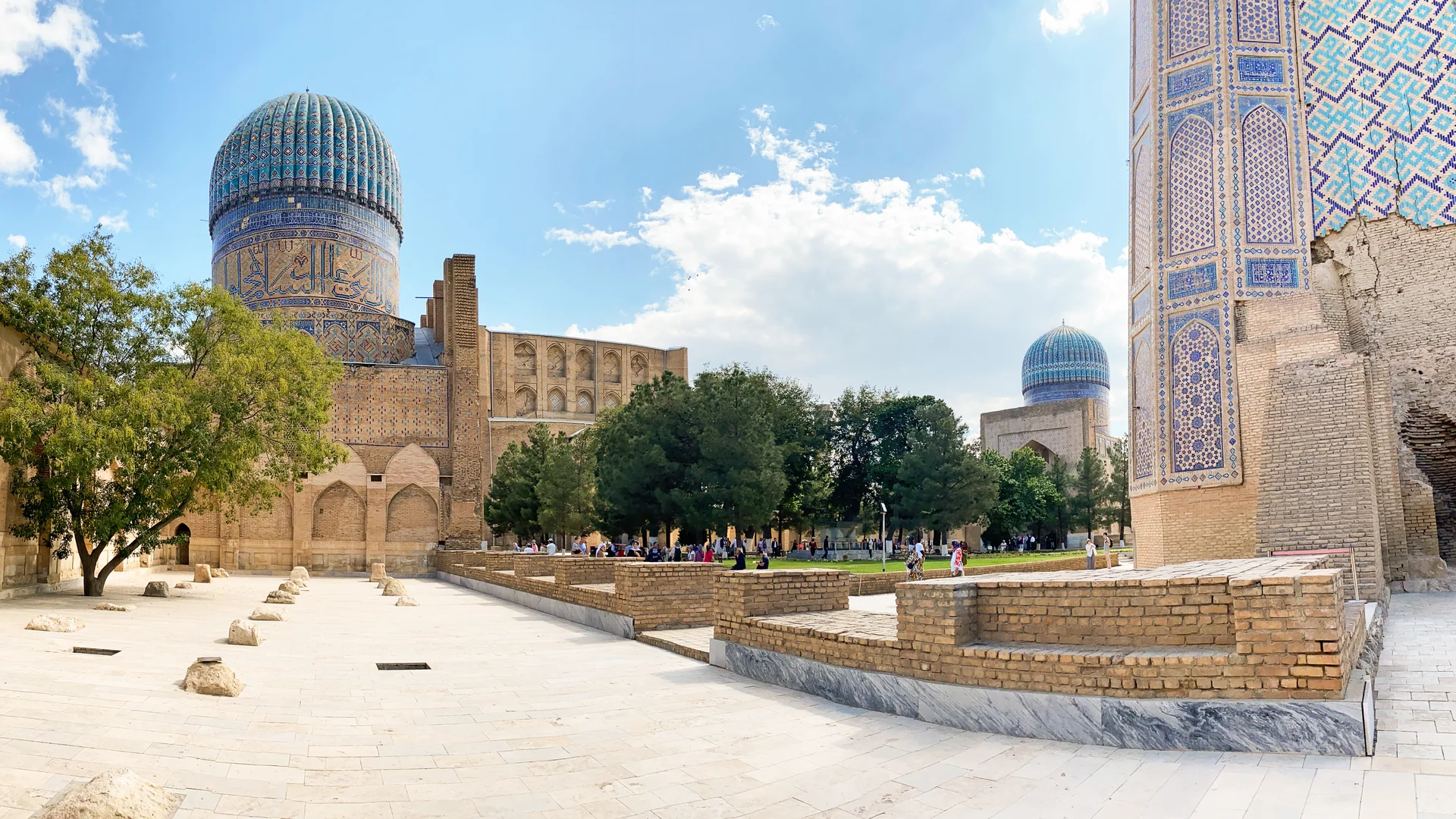
Its scale is best understood from the courtyard, where the four-iwan plan, great portal and detached Qur’an stand can be read together.
Why it matters
Visit Bibi-Khanym Mosque to understand a distinct layer of Samarkand’s history and visitor landscape.
Highlights
- Origins and context
- Architecture and meaning
- Later history and interpretation
Gallery
Practical notes
Dress respectfully and keep voices low in active sacred spaces. Check current access locally; religious use takes priority.
Suggested visit: 60 min.
Add this place to your Uzbekistan journey.
Save the places that interest you, arrange the order, then request transport directly in WhatsApp.