
The story
Historical context
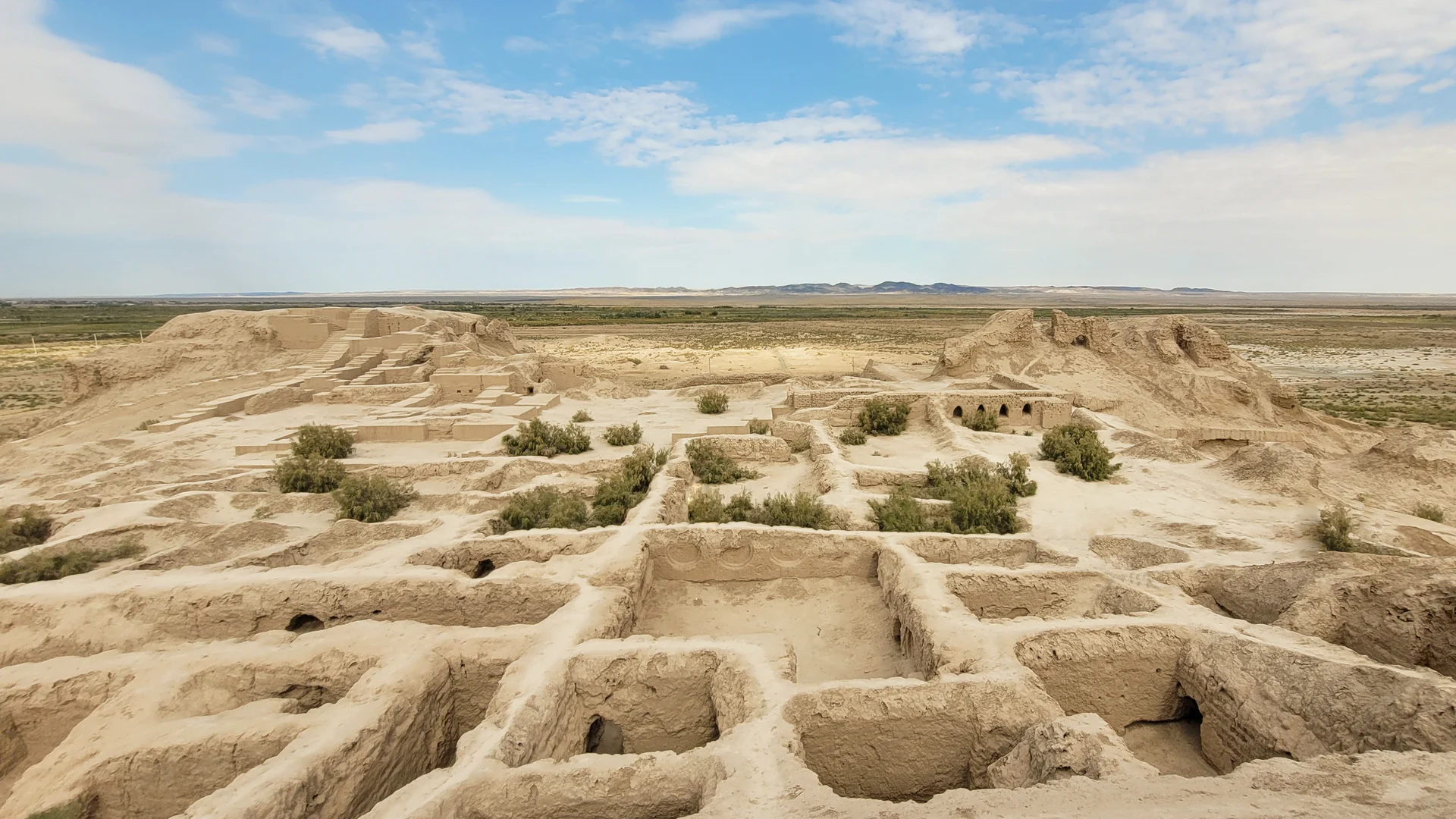
Toprak Kala developed as a walled settlement in ancient Khorezm, with streets, housing, defensive works and a large elevated complex often interpreted as a palace and administrative centre.
Archaeology and material evidence
Excavations recovered wall paintings, sculpture, documents and objects that transformed knowledge of Khorezmian political and cultural life. Important finds are preserved in museums, not left in the rooms where they were discovered.
Interpretation and uncertainty
The surviving mud-brick walls are archaeological remains, not a complete fortress. Reconstructed profiles and eroded rooms require cautious reading and responsible movement.
Visiting responsibly
The site is physically in modern Karakalpakstan even though it is marketed within the broader historical landscape of ancient Khorezm.
Why it matters
Visit Toprak Kala to understand a distinct part of Karakalpakstan’s cultural or environmental landscape.
Highlights
- Historical context
- Archaeology and material evidence
- Interpretation and uncertainty
Gallery
Practical notes
Allow time to understand both the lower town and elevated complex. Do not climb unstable walls; expect heat, wind and little shade.
Suggested visit: 120 min.
Add this place to your Uzbekistan journey.
Save the places that interest you, arrange the order, then request transport directly in WhatsApp.